Pakistan
From Wikipedia, the free encyclopedia
| Islamic Republic of Pakistan
اسلامی جمہوریہ پاکِستان
Islāmī Jumhūrī-ye Pākistān
|
|
|
Motto: اتحاد، تنظيم، يقين مُحکم
Ittehad, Tanzim, Yaqeen-e-Muhkam (Urdu)
"Unity, Discipline and Faith" |
| Anthem: "Qaumi Tarana" |
|
|
| Capital |
Islamabad
 33°40′N 73°10′E / 33.667°N 73.167°E / 33.667; 73.167 33°40′N 73°10′E / 33.667°N 73.167°E / 33.667; 73.167 |
| Largest city |
Karachi |
| Official language(s) |
Urdu (National)
English (Government) |
| Regional languages |
Punjabi, Pashto, Sindhi, Seraiki and Balochi |
| Demonym |
Pakistani |
| Government |
Federal semi-presidential republic |
| - |
President |
Asif Zardari (PPP) |
| - |
Prime Minister |
Yousaf Gillani (PPP) |
| - |
Chair of Senate |
Farooq Naek (PPP) |
| - |
House Speaker |
Fahmida Mirza (PPP) |
| - |
Chief Justice |
Iftikhar Chaudhry |
| Formation |
| - |
Independence |
from the United Kingdom |
| - |
Declared |
14 August 1947 |
| - |
Islamic republic |
23 March 1956 |
| Area |
| - |
Total |
803,940 km2 (36th)
340,403 sq mi |
| - |
Water (%) |
3.1 |
| Population |
| - |
2010 estimate |
168,840,500[1] (6th) |
| - |
1998 census |
132,352,279[2] |
| - |
Density |
210/km2 (55th)
496/sq mi |
| GDP (PPP) |
2008 estimate |
| - |
Total |
$422.392 billion[3] (27th) |
| - |
Per capita |
$2,624[3] (133rd) |
| GDP (nominal) |
2008 estimate |
| - |
Total |
$164.557 billion[3] (48th) |
| - |
Per capita |
$1,022[3] (142nd) |
| Gini (2002) |
30.6 (medium) |
| HDI (2007) |
▲ 0.572[4] (medium) (141st) |
| Currency |
Pakistani Rupee (Rs.) (PKR) |
| Time zone |
PST (UTC+5) |
| - |
Summer (DST) |
PDT (UTC+6) |
| Drives on the |
left[5] |
| Internet TLD |
.pk |
| Calling code |
92 |
Pakistan (
Urdu:
پاکِستان), officially the
Islamic Republic of Pakistan, is a country in
South Asia. It has a 1,046-kilometre (650 mi) coastline along the
Arabian Sea and
Gulf of Oman in the south and is bordered by
Afghanistan and
Iran in the west,
India in the east and
China in the far northeast.
[6] Tajikistan also lies very close to Pakistan but is separated by the narrow
Wakhan Corridor. Thus, it occupies a crossroads position between South Asia, Central Asia and the Middle East.
[7] The region forming modern Pakistan was at the heart of the ancient
Indus Valley Civilisation and then later was the recipient of
Vedic,
Persian,
Indo-Greek,
Turco-Mongol,
Islamic and
Sikh cultures. The area has witnessed invasions and/or settlements by the
Indo-Aryans,
Persians,
Greeks,
Arabs,
Turks,
Afghans,
Mongols and the
British.
[8]
In addition to the
Indian independence movement which demanded an independent India, the
Pakistan Movement (led by
Quaid e Azam Muhammad Ali Jinnah of the
Muslim League), in addition to independent India, sought independent states for the majority
Muslim populations of the eastern and western regions of
British India
as well. The British granted independence and also the creation of one
Muslim majority state of Pakistan that comprised the provinces of
Sindh,
North-West Frontier Province,
West Punjab,
Balochistan and
East Bengal. With the adoption of its
constitution in 1956, Pakistan became an
Islamic republic. In 1971, a
civil war in
East Pakistan resulted in the creation of
Bangladesh.
Pakistan's history has been characterized by periods of
military rule and
political instability. It is also the
sixth most populous country in the world and has
the second largest Muslim population after
Indonesia.
[9] Pakistan also has the second largest
Shia Muslim population.
[10] It is the only
Muslim-majority nuclear state. Pakistan is a member of the
Commonwealth of Nations,
Next Eleven economies,
D8, the
United Nations, and a
Major non-NATO ally of the
United States.
Etymology
The name
Pakistan (
Urdu pronunciation: [paːkɪsˈtaːn] ( listen)
) means
Land of (the) Pure in
Urdu and
Persian (
Farsi). It was coined in 1934 as
Pakstan by
Choudhary Rahmat Ali, a Pakistan movement activist, who published it in his pamphlet
Now or Never.
[11] The name is a
portmanteau representing the "thirty million Muslims of PAKISTAN, who live in the five Northern Units of
British Raj —
Punjab,
Afghania (now known as North-West Frontier Province),
Kashmir,
Sindh, and
Balochistan."
[12]
History
Ancient History

"The Priest King" Wearing Sindhi Ajruk, ca. 2500 BC.
National Museum, Karachi, Pakistan
The
Indus region, which covers a considerable amount of Pakistan, was the site of several ancient cultures including the Neolithic era's
Mehrgarh and the bronze era
Indus Valley Civilisation (2500 BCE – 1500 BCE) at
Harappa and
Mohenjo-Daro.
[13]
Waves of conquerors and migrants from the west — including Harappan,
Indo-Aryans,
Persians,
Greeks,
Sakas,
Parthians,
Kushans,
Hephthalites,
Afghans,
Arabs,
Turks and
Mughals — settled in the region throughout the centuries, influencing the locals and being absorbed among them.
[14] Ancient empires of the east — such as the
Nandas,
Mauryas,
Sungas,
Guptas and the
Palas — ruled these territories at different times from
Patliputra.
[15]
However, in the medieval period, while the eastern provinces of Punjab and Sindh grew aligned with
Indo-Islamic civilisation, the western areas became culturally allied with the
Iranian civilisation of
Afghanistan and
Iran.
[16] The region served as a crossroads of historic trade routes, including the
Silk Road, and as a maritime entreport for the coastal trade between
Mesopotamia and beyond up to
Rome in the west and
Malabar and beyond up to China in the east.
[17]
Modern day Pakistan was at the heart of the Indus Valley
Civilisation; that collapsed in the middle of the second millennium BCE
and was followed by the
Vedic Civilisation, which also extended over much of the Indo-Gangetic plains. Successive ancient empires and kingdoms ruled the region: the
Achaemenid Persian empire around 543 BCE,
[18] the Greek empire founded by
Alexander the Great in 326 BCE and the
Mauryan empire thereafter.
[19]
The
Indo-Greek Kingdom founded by
Demetrius of Bactria included
Gandhara and
Punjab from 184 BCE, and reached its greatest extent under
Menander, establishing the
Greco-Buddhist period with advances in trade and culture. The city of
Taxila (Takshashila) became a major centre of learning in ancient times — the remains of the city, located to the west of
Islamabad, are one of the country's major
archaeological sites.
[20] The
Rai Dynasty (c.489–632) of
Sindh, at its zenith, ruled this region and the surrounding territories.
[21]
Arrival of Islam
In 712
CE, the Arab general
Muhammad bin Qasim conquered
Sindh and
Multan in southern
Punjab.
[22] The Pakistan government's official chronology states that "its foundation was laid" as a result of this conquest.
[23] This
Arab and
Islamic victory would set the stage for several successive Muslim empires in South Asia, including the
Ghaznavid Empire, the
Ghorid Kingdom, the
Delhi Sultanate and the
Mughal Empire. During this period,
Sufi missionaries played a pivotal role in converting a majority of the regional Buddhist and Hindu population to
Islam. The gradual decline of the Mughal Empire in the early eighteenth century provided opportunities for the
Afghans,
Balochis and
Sikhs to exercise control over large areas until the
British East India Company gained ascendancy over South Asia.
[24] The
Indian Rebellion of 1857, also known as the
Sepoy Mutiny,
was the region's last major armed struggle against the British Raj, and
it laid the foundations for the generally unarmed freedom struggle led
by the
Indian National Congress in the twentieth century. In the 1920s and 1930s, a movement led by the
Hindu politician
Mahatma Gandhi, and displaying commitment to long enshrined
Hindu tenet of
ahimsa, or non-violence, engaged millions of protesters in mass campaigns of
civil disobedience.
[25]
Independence Movement
The
All India Muslim League
rose to popularity in the late 1930s amid fears of under-representation
and neglect of Muslims in politics. On 29 December 1930,
Allama Iqbal's
presidential address called for an autonomous "state in northwestern
India for Indian Muslims, within the body politic of India."
[26] Quaid e Azam Muhammad Ali Jinnah espoused the
Two Nation Theory and led the Muslim League to adopt the
Lahore Resolution of 1940, popularly known as the
Pakistan Resolution. In early 1947, Britain announced the decision to end its
rule in India. In June 1947, the nationalist leaders of
British India — including Nehru and
Abul Kalam Azad on behalf of the Congress, Jinnah representing the Muslim League, and
Master Tara Singh representing the
Sikhs — agreed to the proposed terms of transfer of power and independence.
The modern state of Pakistan was established on 14 August 1947 (27
Ramadan 1366 in the
Islamic Calendar), carved out of the two Muslim-majority wings in the eastern and northwestern regions of
British India and comprising the provinces of
Balochistan,
East Bengal, the
North-West Frontier Province,
West Punjab and
Sindh.
[27] The controversial, and ill-timed,
division of the provinces
of Punjab and Bengal caused communal riots across India and Pakistan —
millions of Muslims moved to Pakistan and millions of Hindus and
Sikhs moved to India. Disputes arose over several
princely states including Muslim-majority
Jammu and Kashmir, whose
Hindu ruler had acceded to India following an invasion by Pashtun tribal militias, leading to the
First Kashmir War in 1948.
[28]
From 1947 to 1956, Pakistan was a
Dominion in the
Commonwealth of Nations. It became a Republic in 1956, but the civilian rule was stalled by a
coup d’état by General
Ayub Khan, who was president during 1958–69, a period of internal instability and a
second war with India in 1965. His successor,
Yahya Khan (1969–71) had to deal with a devastating
cyclone
— which caused 500,000 deaths in East Pakistan — and also face a civil
war in 1971. Economic grievances and political dissent in
East Pakistan led to violent political tension and
military repression that escalated into a
civil war.
[29] After nine months of guerrilla warfare between the
Pakistan Army and the Indian backed Bengali
Mukti Bahini militia, Indian intervention escalated into the
Indo-Pakistani War of 1971, and ultimately to the secession of East Pakistan as the independent state of
Bangladesh.
[30]
Civilian rule resumed in Pakistan from 1972 to 1977 under
Zulfikar Ali Bhutto, until he was deposed and later sentenced to death in 1979 by General
Zia-ul-Haq, who became the country's third military president. Zia introduced the Islamic
Sharia
legal code, which increased religious influences on the civil service
and the military. With the death of President Zia in a plane crash in
1988,
Benazir Bhutto,
daughter of Zulfikar Ali Bhutto, was elected as the first female Prime
Minister of Pakistan. Over the next decade, she fought for power with
Nawaz Sharif as the country's political and economic situation worsened. Pakistan got involved in the 1991
Gulf War and sent 5,000 troops as part of a U.S.-led coalition, specifically for the defence of
Saudi Arabia.
[31]
Military tensions in the
Kargil conflict with India were followed by a
Pakistani military coup d'état in 1999 in which General
Pervez Musharraf assumed vast executive powers.
[32][33] In 2001, Musharraf became
President after the controversial resignation of
Rafiq Tarar. After the 2002 parliamentary elections, Musharraf transferred executive powers to the newly-elected Prime Minister
Zafarullah Khan Jamali, who was succeeded in the 2004 prime-ministerial election by
Shaukat Aziz.
On 15 November 2007, the National Assembly, for the first time in
Pakistan's history, completed its tenure and new elections were called.
The exiled political leaders Benazir Bhutto and Nawaz Sharif were
permitted to return to Pakistan. However, the
assassination of Benazir Bhutto during the election campaign in December led to postponement of elections and nationwide riots. Bhutto's
Pakistan Peoples Party (PPP) won the largest number of seats in the elections held in February 2008 and its member
Yousaf Raza Gillani was sworn in as Prime Minister.
[34] On 18 August 2008, Pervez Musharraf resigned from the presidency when threatened to faced with
impeachment,
[35] and was succeeded by current president
Asif Ali Zardari. By the end of 2009, more than 3 million Pakistani civilians have been displaced by the on going
conflict in North-West Pakistan between the government and Taliban militants.
[36]
Government and politics
Pakistan is a
semi-presidential federal democratic republic with
Islam as the state religion.
[37] The first
Constitution of Pakistan was adopted in 1956, but was suspended in 1958 by General
Ayub Khan. The Constitution of 1973 — suspended in 1977, by
Zia-ul-Haq, but re-instated in 1985 — is the country's most important document, laying the foundations of the current government.
[14]
The
bicameral legislature comprises a 100-member
Senate and a 342-member
National Assembly. The
President is the
Head of State and the
Commander in Chief of the Armed Forces and is elected by an
electoral college. The
prime minister
is usually the leader of the largest party in the National Assembly.
Each province has a similar system of government with a directly
elected Provincial Assembly in which the leader of the largest party or
alliance becomes Chief Minister. Provincial Governors are appointed by
the President.
[37]
The
Pakistani military has played an influential role in mainstream
politics throughout Pakistan's history, with military presidents ruling from 1958–71, 1977–88 and from 1999–2008.
[38] The leftist
Pakistan Peoples Party, led by
Zulfikar Ali Bhutto, won support after the loss of
East Pakistan but was overthrown amidst riots in 1977.
[39] Under the military rule of
Muhammad Zia-ul-Haq, during the 1980s, the anti-
feudal, pro-
Muhajir Muttahida Qaumi Movement (MQM) was started by unorthodox and educated urban dwellers of
Sindh and particularly
Karachi. A politically
nationalist insurgency in Balochistan was also bloodlessly
quelled by military
governor Rahimuddin.
[40] The 1990s were characterized by coalition politics dominated by the Pakistan Peoples Party and a rejuvenated Muslim League.
[37]
Pakistan is an active member of the United Nations (UN) and the
Organisation of the Islamic Conference (OIC), the latter of which
Pakistan has used as a forum for
Enlightened Moderation, a plan to promote a
renaissance and
enlightenment in the Muslim world.
[37] Pakistan is also a member of the
South Asian Association for Regional Cooperation (SAARC) and the Economic Cooperation Organisation (ECO).
[37]
In the past, Pakistan has had mixed relations with the United States;
in the early 1950s, Pakistan was the United States' "most allied ally
in Asia"
[42] and a member of both the
Central Treaty Organisation (CENTO) and the
Southeast Asia Treaty Organisation (SEATO).
During the
Soviet-Afghan War in the 1980s Pakistan was a major U.S. ally.
[43]
But relations soured in the 1990s, when sanctions were imposed by the
U.S. over Pakistan's refusal to abandon its nuclear activities.
[44] However, the American
War on Terrorism, as an aftermath of
11 September 2001 attacks in U.S.A., led to an improvement in U.S.–Pakistan ties, especially after Pakistan ended its support of the
Taliban regime in
Kabul.
Its positive side was evidenced by a major increase in American
military aid, providing Pakistan $4 billion more in three years after
the 9/11 attacks than before.
[45]
On the other hand, Pakistan is presently burdened with nearly 3 million
displaced civilians due to the ongoing Afghan war. Since 2004, Pakistan
has been referred to as part of the
Greater Middle East by the U.S.
[46]
On 18 February 2008, Pakistan held its
general elections after
Benazir Bhutto's assassination postponed the original date of 8 January 2008.
[47] The Pakistan Peoples Party won the majority of the votes and formed an alliance with the
Pakistan Muslim League (N). They nominated and elected
Yousaf Raza Gilani as
Prime Minister of Pakistan.
[48] On 18 August 2008, Pervez Musharraf resigned as President of Pakistan amidst increasing calls for his
impeachment.
[49] In the presidential election that followed,
Asif Ali Zardari of Pakistan People's Party won by a landslide majority and became President of Pakistan.
[50]
Subdivisions
Pakistan is a
federation of four provinces, a capital territory and federally administered tribal areas. The government of Pakistan exercises
de facto jurisdiction over the western parts of the disputed
Kashmir region,
[6] organized as two separate political entities (
Azad Kashmir and
Gilgit-Baltistan). The third tier of government was composed of 26
divisions with two further tiers (
districts and
tehsils) administered directly from the provincial level. The divisions were abolished in 2001
[51] and a new three-tiered system of local government came into effect comprising districts, tehsils and
union councils
with an elected body at each tier. There are currently 107 districts in
Pakistan proper, each with several tehsils and union councils. The
tribal areas comprise seven tribal agencies and six
Provinces:
Federal Territories:
Autonomous State:
Territory:
Demographics

Population density in Pakistan
The estimated
population of Pakistan in 2009 was over 180,800,000
[52][53] making it the world's sixth most-populous country, behind
Brazil and ahead of
Russia. By the year 2020, the country's population is expected to reach 220 million, owing to a relatively high growth rate.
[54] About 20% of the population live below the international poverty line of US$1.25 a day.
[55]
Population projections for Pakistan are relatively difficult because of
the differences in the accuracy of each census and the inconsistencies
between various surveys related to the fertility rate, but it is likely
that the rate of growth peaked in the 1980s and has since declined
significantly.
[56] Life expectancy at birth was 63 for females and 62 for males in 2006.
[57] Healthy life expectancy at birth was at 54 for males and 52 for females in 2003.
[57] Expenditure on health was at 2% of the GDP in 2006.
[57] The mortality below 5 was at 97 per 1,000 live births in 2006.
[57]
The majority of southern Pakistan's population lives along the
Indus River. By population size,
Karachi is the largest city of Pakistan.
[58] In the northern half, most of the population lives about an arc formed by the cities of
Lahore,
Faisalabad,
Rawalpindi,
Islamabad,
Gujranwala,
Sialkot,
Gujrat,
Jhelum,
Sargodha and
Sheikhupura.
In the past, the country's population had a relatively high growth rate
that has, however, been moderated by declining fertility and birth
rates. Dramatic social changes have led to rapid urbanization and the
emergence of
megacities. During 1990–2003, Pakistan sustained its historical lead as the most urbanized nation in
South Asia, with city dwellers making up 36% of its population.
[59]
Pakistan has a multicultural and multi-ethnic society and hosts one
of the largest refugee populations in the world as well as a young
population. About 8 million
Muhajirs—then roughly one-fourth of the country’s population—arrived from India after independence in 1947.
[60] The
Urdu-speaking Muhajirs make up nearly half of Karachi's 17 million residents,
[61] with Punjabis and Pashtuns also having sizable communities in the city.
[62] Approximately 1.7 million
Afghan refugees remain in the country, about half of them were born and grew up in Pakistan during the last 30 years.
[63] They are not counted in the national census, even the ones born in Pakistan, because they are still considered
citizens of Afghanistan.
Cities by population (2010 estimate)[64]
| Rank |
City |
Location |
Population |
Rank |
City |
Location |
Population |

Karachi, Sindh

Lahore, Punjab
|
| 1 |
Karachi |
Sindh |
13,205,339 |
11 |
Sargodha |
Punjab |
600,501 |
| 2 |
Lahore |
Punjab |
7,129,609 |
12 |
Bahawalpur |
Punjab |
543,929 |
| 3 |
Faisalabad |
Punjab |
2,880,675 |
13 |
Sialkot |
Punjab |
510,863 |
| 4 |
Rawalpindi |
Punjab |
1,991,656 |
14 |
Sukkur |
Sindh |
493,438 |
| 5 |
Multan |
Punjab |
1,606,481 |
15 |
Larkana |
Sindh |
456,544 |
| 6 |
Hyderabad |
Sindh |
1,578,367 |
16 |
Sheikhupura |
Punjab |
426,980 |
| 7 |
Gujranwala |
Punjab |
1,569,090 |
17 |
Jhang |
Punjab |
372,645 |
| 8 |
Peshawar |
NWFP |
1,439,205 |
18 |
Rahim Yar Khan |
Punjab |
353,112 |
| 9 |
Quetta |
Balochistan |
896,090 |
19 |
Mardan |
NWFP |
352,135 |
| 10 |
Islamabad |
Capital Territory |
689,249 |
20 |
Gujrat |
Punjab |
336,727 |
Languages
Pakistan is a
multilingual country with more than sixty languages being spoken. English is the
official language of Pakistan and used in official business, government, and legal contracts,
[14] while
Urdu is the
national language.

Major Ethnic Groups in Pakistan
Punjabi is the provincial language of
Punjab.
Pashto is the provincial language of
North-West Frontier Province.
Sindhi is the provincial language of
Sindh and
Balochi is the provincial language of
Balochistan.
[65]
Other languages include Aer,
Badeshi,
Bagri,
Balti, Bateri,
Bhaya,
Brahui,
Burushaski, Chilisso,
Dameli,
Dehwari,
Dhatki,
Domaaki,
Farsi (Dari), Gawar-Bati, Ghera, Goaria, Gowro,
Gujarati,
Gujari, Gurgula,
Hazaragi,
Hindko (two varieties), Jadgali, Jandavra, Kabutra,
Kachchi (Kutchi),
Kalami,
Kalasha, Kalkoti, Kamviri,
Kashmiri, Kati,
Khetrani,
Khowar, Indus Kohistani, Koli (three varieties), Lasi, Loarki,
Marwari,
Memoni, Od,
Ormuri,
Pahari-Potwari, Pakistan Sign Language,
Palula (Phalura), Sansi, Savi,
Shina (two varieties),
Torwali, Ushojo, Vaghri,
Wakhi, Waneci, and
Yidgha.
[66]
Some of these are endangered languages with a relatively small number
of speakers and others have hundreds of thousands of speakers. Most of
the languages belong to the
Indo-Iranian branch of the
Indo-European family. The exceptions are
Burushaski, which is a
language isolate;
Balti, which is
Sino-TIbetan; and Brahui, which is
Dravidian.
Religions
Pakistan is the second-most populous
Muslim-majority country[9][67] and also has the second-largest
Shi'a population in the world.
[10] About 95% of the Pakistanis are
Muslim, of which nearly 75% are
Sunni and 20% are
Shi'a.
[14] Although the two groups of Muslims usually coexist peacefully, sectarian violence occurs sporadically.
[68]
The religious breakdown of the country is as follows:
[14]
- Islam 173,000,000 (96%) (nearly 70% are Sunni Muslims and 20% are Shi'a Muslims).
- Hinduism 3,200,000 (1.85%)
- Christianity 2,800,000 (1.6%)
- Sikhs Around 20,000 (0.001%)
- The remaining are Parsis, Ahmadi Muslims, Buddhists, Jews, Bahá'ís, and Animists (mainly the Kalasha of Chitral).[69]
Military
The
armed forces of Pakistan are an all-volunteer force and the
sixth-largest in the world. The three main services are the
Army,
Navy and the
Air Force, supported by a number of
paramilitary forces which carry out internal security roles and border patrols. The
National Command Authority is responsible for exercising employment and development control of all strategic nuclear forces and organizations.
The Pakistan military first saw combat in the
First Kashmir War, gaining control of what is now
Azad Kashmir. In 1961, the army repelled a major
Afghan incursion on Pakistan's western border.
[70] Pakistan and India would be at war again in
1965 and in
1971. In 1973, the military quelled a
Baloch nationalist uprising. During the
Soviet-Afghan war, Pakistan shot down several intruding pro-Soviet Afghan aircraft and provided covert support to the
Afghan mujahideen through the
Inter-Services Intelligence agency. In 1999, Pakistan was involved in the
Kargil conflict with India. Currently, the military is engaged in an
armed conflict with extremist Islamic militants in the north-west of the country.
The Pakistani armed forces contributed to
United Nations peacekeeping efforts, with more than 10,700 personnel deployed in 2009,
[71]
and are presently the largest contributor. In the past, Pakistani
personnel have volunteered to serve alongside Arab forces in conflicts
with
Israel. Pakistan provided a military contingent to the U.N.-backed coalition in the first
Gulf War.
[72]
Pakistan's military employs armaments that include atomic weapons,
mobile vehicle ballistic missile systems, laser communication systems,
armored cars and tanks, and multi-role fighter/bomber jets.
Since 2004, Pakistani armed forces are engaged in fighting against
Pakistani Taliban groups.
Ever since the militant groups have been retaliating by suicide
bombings in Pakistani cities, killing more than 3,000 civilians and
armed personnels only in 2009.
[73]
Geography and climate

The
Baltoro Glacier, Northern Pakistan, is one of the longest glaciers outside of the polar regions.

K2 is the highest peak in Pakistan and 2nd highest peak on
earth
Pakistan covers 340,403 square miles (881,640 km
2),
[74] approximately equalling the combined land areas of France and the United Kingdom. Its eastern regions are located on the
Indian tectonic plate and the western and northern regions on the
Iranian plateau and
Eurasian landplate. Apart from the 1,046-kilometre (650 mi)
Arabian Sea
coastline, Pakistan's land borders total
6,774 kilometres—2,430 kilometres (1,509 mi) with Afghanistan to the
northwest, 523 kilometres (325 mi) with China to the northeast,
2,912 kilometres (1,809 mi) with India to the east and 909 kilometres
(565 mi) with Iran to the southwest.
[14]
The northern and western highlands of Pakistan contain the towering
Karakoram and Pamir mountain ranges, which incorporate some of the
world's highest peaks, including
K2 (28,250 ft; 8,611 m) and
Nanga Parbat (26,660 ft; 8,126 m).
The
Balochistan Plateau lies to the West, and the
Thar Desert in the East. An expanse of alluvial plains lies in Punjab and Sindh along the Indus river. The 1,000-mile-long (1,609-km)
Indus River and its tributaries flow through the country from the Kashmir region to the Arabian Sea.
[75]
Pakistan has four seasons: a cool, dry winter from December through
February; a hot, dry spring from March through May; the summer rainy
season, or southwest monsoon period, from June through September; and
the retreating monsoon period of October and November. The onset and
duration of these seasons vary somewhat according to location.
[76] Rainfall can vary radically from year to year, and successive patterns of flooding and drought are also not uncommon.
[77]
Flora and fauna
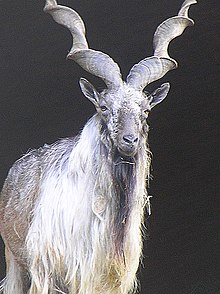
Markhor, Pakistan's national animal
The national animal of Pakistan is the
Markhor and the national bird is the
Chukar, also known as Chakhoor in Urdu.
[78]
The wide variety of landscapes and climates in Pakistan allows for a
wide variety of wild animals and birds. The forests range from
coniferous alpine and
subalpine trees such as spruce, pine, and
deodar cedar in the northern mountains to
deciduous trees such as the mulberry-type Shisham in the
Sulaiman range in the south. The western hills have
juniper and
tamarisk as well as coarse grasses and scrub plants. Along the southern coast are
mangrove forests which form much of the coastal wetlands.
[79]
In the south, there are crocodiles in the murky waters at the mouth
of the Indus River whilst on the banks of the river, there are boars,
deer,
porcupines,
and small rodents. In the sandy scrublands of central Pakistan are
found jackals, hyenas, wild cats, panthers, and leopards while the
clear blue skies abound with hawks, falcons, and eagles. In the
southwestern deserts are rare
Asiatic cheetahs. In the northern mountains are a variety of endangered animals including
Marco Polo sheep,
Urial sheep,
Markhor and
Ibex goats,
black and
brown Himalayan bears, and the rare
Snow Leopard. During August 2006, Pakistan donated an orphaned snow leopard cub called Leo to the United States.
[80] Another rare species is the blind
Indus River Dolphin of which there are believed to be about 1,100 remaining, protected at the Indus River Dolphin Reserve in
Sindh.
[81]
In recent years, the number of wild animals being killed for fur and
leather trading led to a new law banning the hunting of wild animals
and birds as well as the establishment of several wildlife sanctuaries
and game reserves. The number of hunters have greatly dwindled since
then.
[82]
Economy

A View of
I. I. Chundrigar Road road, Karachi, which is the
financial hub of pakistan
Pakistan has a semi-industrialized economy.
[83][84] The growth poles of the Pakistani economy are situated along the
Indus River,
[84][85] diversified economies of Karachi and Punjab's urban centers, coexist with lesser developed areas in other parts of the country.
[84]
Despite being a very poor country in 1947, Pakistan's economic growth
rate has been better than the global average during the subsequent four
decades, but imprudent policies led to a slowdown in the late 1990s.
[86] Recently, wide-ranging economic reforms have resulted in a stronger economic outlook and accelerated growth especially in the
manufacturing and
financial services sectors.
[86] Since the 1990s, there has been great improvement in the
foreign exchange position and rapid growth in
hard currency reserves.
[86]
The 2005 estimate of foreign debt was close to US$40 billion.
However, this has decreased in recent years with assistance from the
International Monetary Fund and significant debt-relief from the United States. Pakistan's
gross domestic product, as measured by
purchasing power parity, is estimated to be US$475.4 billion
[87] while its
per capita income stands at $2,942.
[87] The poverty rate in Pakistan is estimated to be between 23%
[88] and 28%.
[89]
GDP growth was steady during the mid 2000s at a rate of 7%;
[90][91] however, slowed down during the
Economic crisis of 2008 to 4.7%.
[14]
A large inflation rate of 24.4% and a low savings rate, and other
economic factors, continue to make it difficult to sustain a high
growth rate.
[92][93]
Pakistan's GDP is US$167 billions, which makes it the 48th-largest
economy in the world or 27th largest by purchasing power adjusted
exchange rates. Today, Pakistan is regarded as to having the second
largest economy in
South Asia.
[94]
The structure of the Pakistani economy has changed from a mainly
agricultural base to a strong service base. Agriculture now only
accounts for roughly 20% of the GDP, while the
service sector accounts for 53% of the GDP.
[95] Significant foreign investments have been made in several areas including
telecommunications, real estate and energy.
[96][97]
Other important industries include apparel and textiles (accounting for
nearly 60% of exports), food processing, chemicals manufacture, and the
iron and steel industries.
[98] Pakistan's exports in 2008 amounted to $20.62 billion (
USD).
[14] Pakistan is a rapidly developing country.
[99][100][101]
However, the
Economic crisis of 2008 led Pakistan to seek more than $100 billion in aid in order to avoid possible bankruptcy.
[102][103] This was never given to Pakistan and therefore it had to depend on a more aggressive fiscal policy, backed by the
IMF. A year later Asian Development Bank Reports Pakistan economic crisis easing in 2009.
[104]
Furthermore it is projected that in 2010 Pakistan economy would grow at
least 4 percent and could grow more with strong international economic
recovery.
[105]
Education
Education in Pakistan is divided into five levels:
primary (grades one through five);
middle (grades six through eight);
high (grades nine and ten, leading to the
Secondary School Certificate);
intermediate (grades eleven and twelve, leading to a Higher Secondary School Certificate); and
university programmes leading to
graduate and
advanced degrees.
[106]
Pakistan also has a parallel secondary school education system in
private schools, which is based upon the curriculum set and
administered by the
Cambridge International Examinations, in place of government exams. Some students choose to take the
O level and
A level[107] exams through the
British Council.
There are currently 730
technical & vocational institutions in Pakistan.
[108] The minimum qualifications to enter male vocational institutions, is the completion of grade 8.
The programmes are generally two to three years in length. The
minimum qualifications to enter female vocational institutions, is the
completion of grade 5.
[111] All academic education institutions are the responsibility of the
provincial governments. The
federal government mostly assists in curriculum development, accreditation and some financing of research.
English medium education is to be extended, on a phased basis, to all schools across the country.
[112]
Through various educational reforms, by the year 2015, the ministry of
education expects to attain 100% enrolment levels amongst primary
school aged children, and a literacy rate of 86% amongst people aged
over 10.
[113]
Pakistan also has
madrassahs
that provide free education and also offer free boarding and lodging to
students who come mainly from the poorer strata of society.
[114] After criticism over terrorists using them for recruiting purposes, efforts have been made to regulate them.
[115]
Culture
Pakistani society is largely
hierarchical, with high regard for traditional Islamic values, although urban families have grown into a
nuclear family system because of the socio-economic constraints imposed by the traditional
joint family system.
[116] Recent decades have seen the emergence of a middle class in cities like
Karachi,
Lahore,
Rawalpindi,
Hyderabad,
Faisalabad,
Multan and
Peshawar
that wish to move in a more centrist direction, as opposed to the
northwestern regions bordering Afghanistan that remain highly
conservative and dominated by centuries-old regional
tribal customs. Increasing
globalization has resulted in ranking 46th on the
A.T. Kearney/
FP Globalization Index.
[117]
The variety of
Pakistani music ranges from diverse provincial
folk music and traditional styles such as
Qawwali and
Ghazal Gayaki
to modern forms fusing traditional and western music, such as the
synchronisation of Qawwali and western music by the world renowned
Nusrat Fateh Ali Khan. In addition Pakistan is home to many famous folk singers such as the late
Alam Lohar, who is also well known in
Indian Punjab. However, majority of Pakistanis listen to Indian music produced by Bollywood and other Indian film industries. The arrival of
Afghan refugees in the western provinces has rekindled
Pashto and
Persian music and established
Peshawar as a hub for Afghan musicians and a distribution centre for Afghan music abroad.
[118]
State-owned
Pakistan Television Corporation (PTV) and
Pakistan Broadcasting Corporation
were the dominant media outlets, but there are now numerous private
television channels. Various American, European, and Asian television
channels and films are available to the majority of the Pakistani
population via private television networks,
cable, and
satellite television. There are also small indigenous film industries based in Lahore and Peshawar (often referred to as
Lollywood). And while
Bollywood films have been banned from being played in public cinemas since 1965 they have remained popular in popular culture.
[119]
The
architecture of the areas now constituting Pakistan can be designated to four distinct periods—
pre-Islamic,
Islamic,
colonial and
post-colonial. With the beginning of the
Indus civilization around the middle of the
3rd millennium B.C.,
[120] an advanced
urban culture developed for the first time in the region, with large structural facilities, some of which survive to this day.
[121] Mohenjo Daro,
Harappa and
Kot Diji belong to the pre-Islamic era settlements. The rise of
Buddhism and the
Persian and
Greek influence led to the development of the
Greco-Buddhist style, starting from the 1st century CE. The high point of this era was reached with the culmination of the
Gandhara style. An example of Buddhist architecture is the ruins of the Buddhist monastery
Takht-i-Bahi in the
northwest province.

A
Kalash man dances during the
Uchau Festival.
The arrival of
Islam in today's Pakistan meant a sudden end of Buddhist architecture.
[122] However, a smooth transition to predominantly pictureless
Islamic architecture occurred. The most important of the few completely discovered buildings of Persian style is the
tomb of the Shah Rukn-i-Alam in
Multan. During the
Mughal era design elements of Islamic-Persian architecture were fused with and often produced playful forms of the Hindustani art.
Lahore, occasional residence of Mughal rulers, exhibits a multiplicity of important buildings from the empire, among them the
Badshahi mosque, the
fortress of Lahore with the famous
Alamgiri Gate, the colourful, still strongly Persian seeming
Wazir Khan Mosque as well as numerous other mosques and mausoleums. Also the
Shahjahan Mosque of
Thatta
in Sindh originates from the epoch of the Mughals. In the British
colonial period, predominantly functional buildings of the
Indo-European representative style developed from a mixture of European
and Indian-Islamic components. Post-colonial national identity is
expressed in modern structures like the
Faisal Mosque, the
Minar-e-Pakistan and the
Mazar-e-Quaid.
The
literature of Pakistan covers the literatures of languages spread throughout the country, namely
Urdu,
Sindhi,
Punjabi,
Pashto,
Baluchi as well as
English[123] and
Persian as well. Prior to the 19th century, the literature mainly consisted of
lyric poetry and
religious,
mystical and
popular materials. During the
colonial age the native literary figures, under the influence of the
western literature of
realism, took up increasingly different topics and telling forms. Today, short stories enjoy a special popularity.
[124]
The national poet of Pakistan,
Allama Muhammad Iqbal, suggested the creation of a separate homeland for the Muslims of India. However, Iqbal had also wrote the
Tarana-e-Hind which stated the belief of a strong united India. His book
The Reconstruction of Religious Thought in Islam
is a major work of modern Islamic philosophy. The most well-known
representative of the contemporary Urdu literature of Pakistan is
Faiz Ahmed Faiz.
Sufi poetry
Shah Abdul Latif,
Bulleh Shah and
Khawaja Farid are also very popular in Pakistan.
[125] Mirza Kalich Beg has been termed the father of modern Sindhi prose.
[126]
Tourism
Despite having an image problem, hyped particularly in the West, and
once alleged as one of the most dangerous countries in the world by the
British magazine "The Economist",
[127] tourism is still a growing industry in Pakistan because of its diverse cultures, peoples and landscapes.
[128] The variety of attractions ranges from the ruins of ancient civilizations such as
Mohenjo-daro,
Harappa and
Taxila, to the Himalayan hill-stations, that attract those interested in field and winter sports. Pakistan also has several
mountain peaks of height over 8,000 metres (26,250 ft), that attract adventurers and mountaineers from around the world, especially to
K2.
[129]
Starting in April to September, domestic and international tourists
visit these areas helping tourism become a source of income for the
local people.
In
Balochistan
there are many caves for cavers and tourists to visit especially the
Juniper Shaft Cave, the Murghagull Gharra cave, Mughall saa cave, and
naturally decorated cave. Pakistan is a member country through
Hayatullah Khan Durrani to the Union International de Spéléologie (UIS).
[130]
The northern parts of Pakistan are home to several historical fortresses, towers and other architecture including the
Hunza and
Chitral valleys, the latter being home to the
Kalash, a small pre-Islamic
Animist community.
[131] Punjab is also the site of Alexander's
battle on the
Jhelum River. The historic city of
Lahore is considered Pakistan's cultural centre and has many examples of
Mughal architecture such as the
Badshahi Masjid,
Shalimar Gardens,
Tomb of Jahangir and the
Lahore Fort.
[132] The Pakistan Tourism Development Corporation (
PTDC) also helps promote tourism in the country.
[133]
However, tourism is still limited because of the lack of proper
infrastructure and the worsening security situation in the country. The
recent militancy in Pakistan's scenic sites, including
Swat
in NWFP province, have dealt a massive blow to the tourism industry.
Many of the troubles in these tourist destinations are also blamed on
the frail travel network, tourism regulatory framework, low
prioritization of the tourism industry by the government, low
effectiveness of marketing and a constricted tourism perception.
[134][135]
After these areas were being cleared off the militant groups in late
2009, the government of Pakistan with the financial support from the
USAID
have started a campaign to reintroduce tourism in Swat valley. Pakistan
receives 500,000 tourists annually, and almost half of them head to
northern Pakistan.
[136]
Sports
The national sport of Pakistan is
field hockey, although
cricket is the most popular game across the country. The national cricket team has won the
Cricket World Cup
once (in 1992), were runners-up once (in 1999), and co-hosted the games
twice (in 1987 and 1996). Pakistan were runners-up in the inaugural
2007 ICC World Twenty20 held in South Africa and are the champions of
2009 ICC World Twenty20
held in England. However, cricket here has suffered heavily due to
teams refusing to tour Pakistan fearing terrorism; no team having
toured Pakistan since March 2009, when militants attacked the touring
Sri Lankan cricket players.
[137] Squash is another sport that Pakistanis have excelled in. Successful world-class squash players such as
Jahangir Khan and
Jansher Khan won the World Open several times during their careers.

Polo is regarded as a traditional sport and played widely in the northern areas
At an international level, Pakistan has competed many times at the
Summer Olympics in field hockey,
boxing,
athletics,
swimming, and
shooting.
Pakistan's medal tally remains at 10 medals (3 gold, 3 silver and 4
bronze) while at the Commonwealth Games and Asian Games it stands at 61
medals and 182 medals respectively. Hockey is the sport in which
Pakistan has been most successful at the Olympics, with three gold
medals in (1960, 1968, and 1984). Pakistan has also won the
Hockey World Cup a record four times (1971, 1978, 1982, 1994). The Motorsport Association of Pakistan is a member of the
Fédération Internationale de l'Automobile.
[138] In caving and adventure sports, Pakistan is member country to UIS (Union of International Speleology)
[130]
The Freedom Rally is a yearly off-road race which takes place during
the Independence celebrations. Pakistan also qualified for the
Golf World Cup for the first time in 2009.
[139]
 Pakistan in Guinness Book of World Records


